← back to work
02Internal Tools
Custom CMS Website Platform
Webuilder, a self-hosted visual site builder and CMS I built with AI-assisted development to replace Webflow across my own sites.
- Role
- Creator & Product Manager
- Year
- 2026
- Client
- Independent
- Stack
- Claude Code, Codex, TypeScript, SQLite
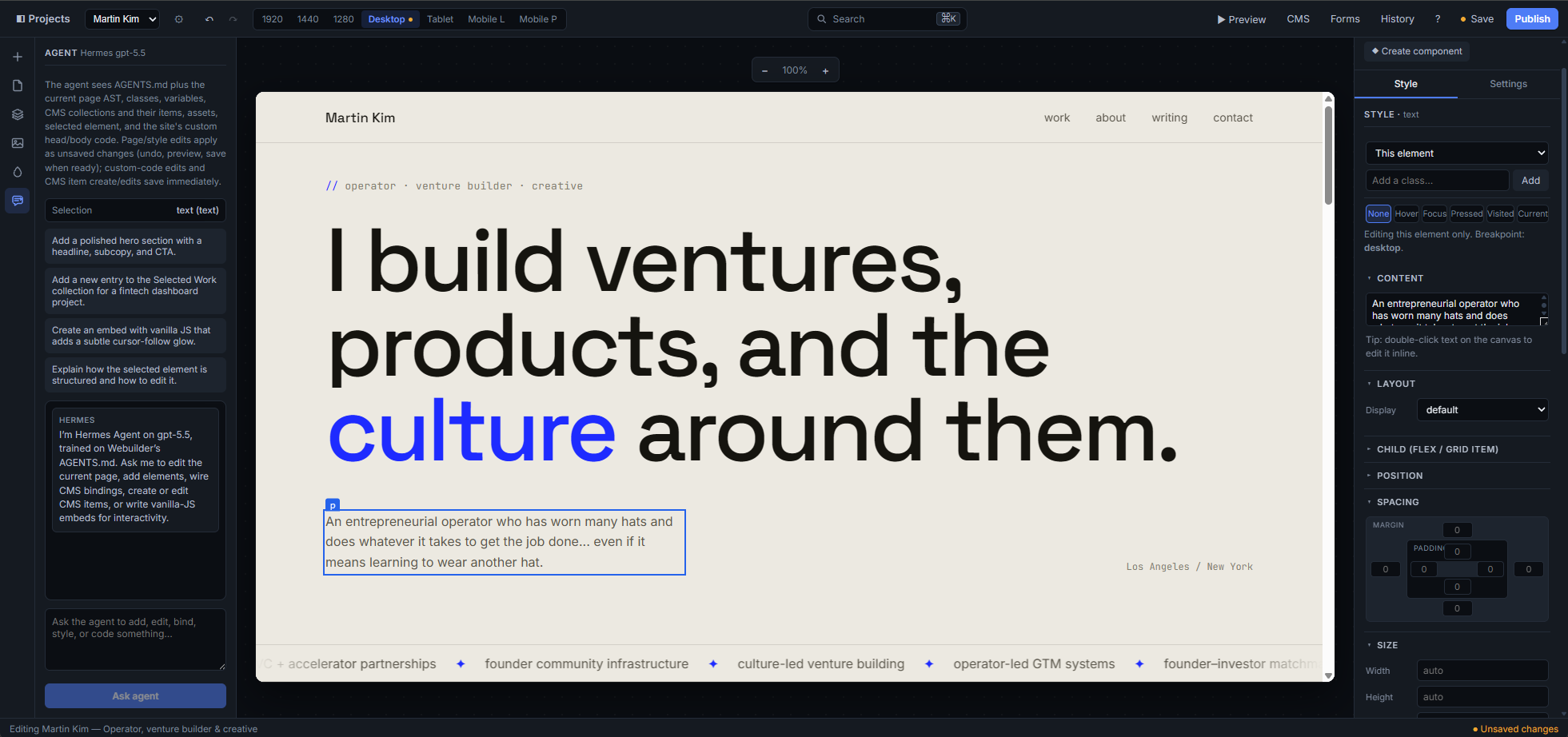
Replaces Webflow
across my own sites
This site
built and published with it
Visual + CMS
editor, collections, publishing
Building Webuilder, a CMS for my own work
I've used Webflow for many years to create websites for clients and for my many side projects for years. Having learned web design from scratch with HTML and CSS, I never gravitated towards the drag & drop UI/UX of Squarespace and the like. That's why when I was honestly excited when I first learned about Webflow. All of the convenience of a cloud-based editor that manages DNS settings for publishing with a robust CMS and, most importantly, complete control over the design experience. Like I said, I happily used it for years.
The problem was that Webflow got really expensive. And when you're managing multiple sites, these costs add up. Around the same time I was dealing with their new cost models, I was also getting comfortable with AI-aided development to make my own custom internal tools. I was putting my product design and product management experience to use working with AI tools like Hermes Agent, Codex, and Claude Code to create tools from scratch that made my life easier; things that either didn't exist or simply cost too much.
I built Webuilder because I kept running into the same problem from different angles: I wanted the freedom of a custom website, the structure of a CMS, and the speed of modern no-code tools, but I did not want to keep paying for platforms that were either too rigid, too expensive, or too far removed from the way I actually work.
The need became especially clear while working on my own portfolio site.
So I started building Webuilder: a custom CMS platform for creating and managing websites with structured content, reusable design patterns, and a visual editing workflow. I finished the project with Claude, using it as a development partner while I owned the product direction, information architecture, design decisions, and implementation tradeoffs.
That distinction matters to me. I do not think of Webuilder as "I asked AI to make a website builder." The hard part was knowing what the tool needed to be. I had to define the product shape, decide which features were actually necessary, translate my own publishing workflow into a CMS structure, test the editor experience, and keep the system focused enough that it could become usable instead of turning into an endless platform fantasy.
The portfolio site where this post is hosted was built using Webuilder. That gave the project a useful constraint: the tool had to serve a real purpose immediately. I was not building a speculative demo. I was building the system I needed in order to publish my own work, organize case studies, and present projects in a way that felt more intentional than a standard template.
A lot of the decisions came from product management instincts. I had to separate the features that sounded impressive from the ones that would actually make the tool better. A CMS does not become useful because it has every possible option. It becomes useful when the content model, editor, design controls, and publishing flow match the job the user is trying to do. In this case, I was the first user, which made the feedback loop brutally direct. If something was clunky, I felt it immediately. If the editor made a simple update too complicated, I had to fix the workflow, not just accept the friction.
Using Claude changed the pace of development, but it did not remove the need for judgment. It helped me move faster through implementation, debugging, refactoring, and UI iteration. But I still had to know when the output was wrong, when a feature was drifting away from the architecture, when the interface was becoming too complicated, and when the product needed a simpler decision. AI made the build more accessible and more affordable. It did not make the product think for itself.
That is what I like most about the project. Webuilder reflects the way I increasingly approach internal tools: identify the recurring workflow, design the system around the actual use case, and use AI to make the build feasible without giving up product judgment. Instead of buying a subscription to a tool that almost fits, I can now build something closer to the workflow I need.
The result is both a working CMS platform and a proof of how I like to operate. Webuilder gives me a more flexible way to maintain my own portfolio, but it also represents a larger pattern in my work: using product design, product management, and AI-assisted development to create internal systems that are cheaper, more tailored, and more directly connected to the problem they are meant to solve.
Next project
Founder–Investor Events